
Russia’s Scheduled 36.7% Wheat Export-Duty Cut: A $5/mt Competitiveness Test
BITAR GLOBAL TRADE — Market Intelligence
Data cut-off: 19 September 2026
Executive Summary
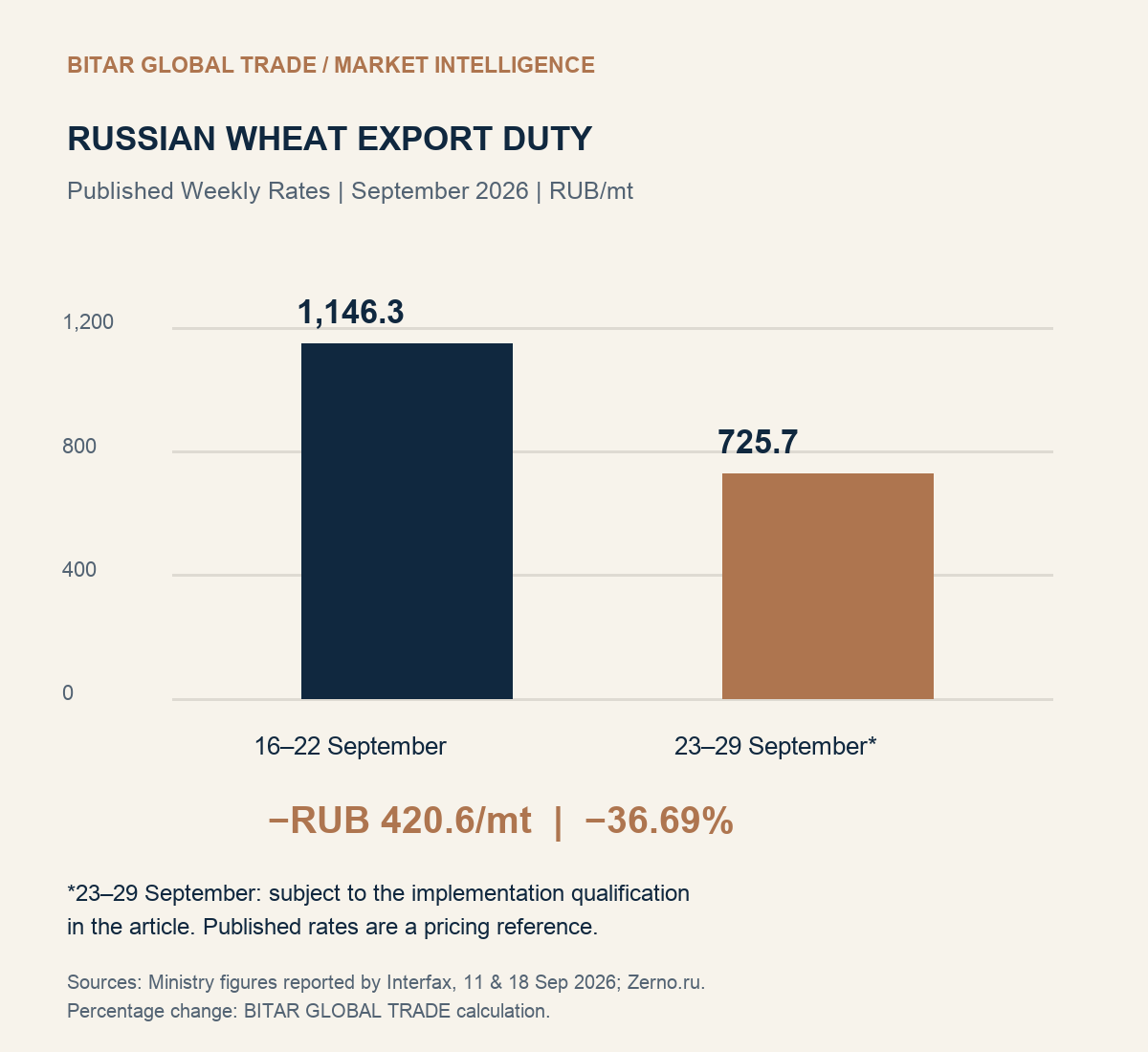
Russia’s published wheat export duty is scheduled to fall by 36.69%, or RUB 420.6/mt, for 23–29 September. At the official exchange rate effective 19 September, that represents approximately $5/mt of potential cost relief.
The reduction creates room for exporters to improve margins, pay more for grain or lower export offers. It does not automatically produce a $5/mt decline in FOB prices.
For buyers, the opportunity is therefore not the duty cut itself, but the possibility of capturing part of that $5/mt through refreshed Russian offers. Egyptian and MENA importers should test those offers against unchanged specifications and shipment terms, then establish whether any FOB improvement survives freight, insurance and execution costs.
What Changed
Published figures, corroborated through reporting citing the Ministry of Agriculture: Wheat and meslin duty declines from RUB 1,146.3/mt for 16–22 September to RUB 725.7/mt for 23–29 September 2026. The administrative indicative wheat price moves from $227.5/mt to $225.9/mt. Corn duty falls from RUB 617.5/mt to RUB 158.4/mt, while barley remains at zero. Interfax, 11 September, Interfax, 18 September
Implementation qualification: The published weekly duty rates should be distinguished from the previously announced suspension decision, whose implementation was reported as awaiting a government decree. Until the applicable customs treatment is confirmed for the relevant shipment period, the analysis below treats the published weekly rates as a pricing reference rather than as a certified payable duty.
The Numbers
Verified reference: The Bank of Russia’s official exchange rate effective 19 September is RUB 84.1975 per USD. It is a conversion reference, not a guaranteed commercial exchange rate. Bank of Russia
| Measure | Value |
|---|---|
| Previous published wheat duty | RUB 1,146.3/mt |
| New published wheat duty | RUB 725.7/mt |
| Calculated reduction | RUB 420.6/mt |
| Calculated percentage reduction | 36.69% |
| Previous duty at the reference exchange rate | $13.61/mt |
| New duty at the reference exchange rate | $8.62/mt |
| Potential cost relief | Approximately $5.00/mt |
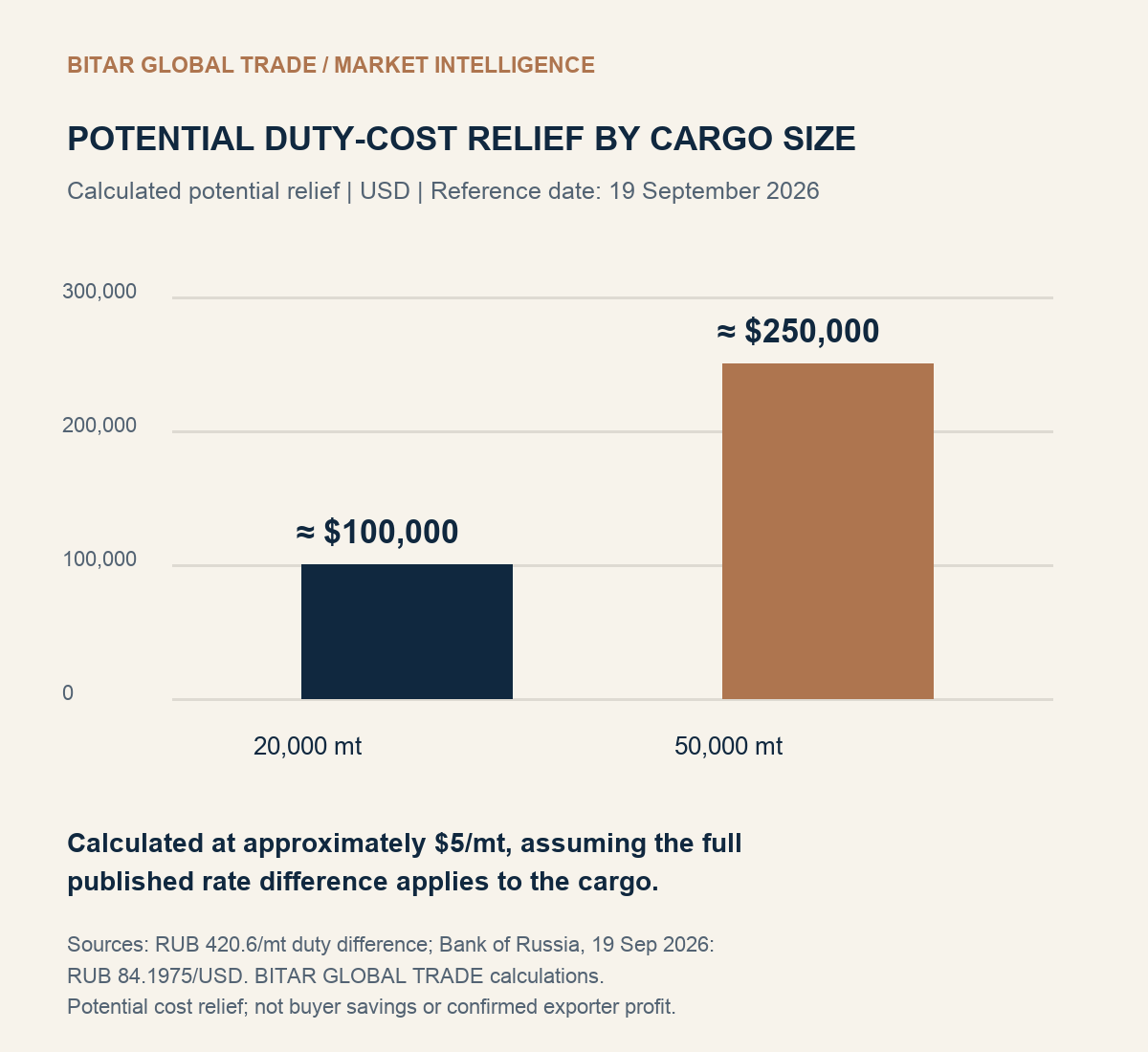
Calculation: RUB 420.6 ÷ 84.1975 = $4.9954/mt, rounded to approximately $5/mt. The published duty figures are also reproduced in the Zerno.ru rate table.
Assuming the full published rate difference applies, the potential relief is approximately $100,000 on 20,000 mt and $250,000 on 50,000 mt. These are cargo-scale calculations, not guaranteed buyer savings or realized exporter profit.
The administrative indicative price used in the duty calculation is not an executable FOB offer.
Commercial Impact on Russian Exporters
Analytical inference: The reduction gives exporters additional commercial flexibility. Where grain procurement and selling prices are already fixed, and other costs remain unchanged, it could improve the exporter’s net return, subject to contractual duty-adjustment provisions.
For new business, the benefit may be distributed across the supply chain:
- Exporter margin: retained to improve returns or recover previously absorbed costs.
- Farmers and suppliers: captured through stronger procurement bids.
- International buyers: passed through in lower executable offers.
- Logistics and execution: absorbed by higher transport, terminal, financing or delay costs.
Which outcome prevails depends on competition for grain, buyers and shipping capacity. Lower duty alone does not establish margin expansion.
Impact on FOB Black Sea Pricing
Exporters are not compelled to reduce FOB offers by the duty saving. A forward quotation may already incorporate anticipated relief, leaving little additional room to negotiate on that basis.
Current evidence does not establish pass-through. No matched executable quotations were identified that demonstrate a price reduction specifically attributable to this announcement. Earlier market declines do not prove anticipation of the new rate.
The following illustrates the isolated effect of different allocations:
| Illustrative sensitivity scenario | Buyer’s FOB saving |
|---|---|
| No pass-through | $0/mt |
| Half pass-through | Approximately $2.50/mt |
| Full pass-through | Approximately $5/mt |
These are illustrative sensitivity scenarios—not observed market behavior, forecasts, probabilities or confirmed exporter pricing decisions. All other costs and pricing factors are held constant.
Russia vs Competing Origins
Analytical inference: A $5/mt duty advantage matters most when Russia’s delivered-cost gap versus competing origins is within roughly the same range.
If two comparable cargoes are closely priced, a Russian FOB improvement could change their competitive ranking. It cannot compensate for a substantially larger disadvantage in freight, insurance, terminal costs, payment structure or loading delays.
Available Baltic offer reporting illustrates differences between ports and individual cargoes, but does not provide sufficiently normalized specifications, shipment terms and freight to serve as a competitiveness benchmark. Reuters-sourced market report, 18 September
Current verified data are insufficient to rank Russian, Romanian, Bulgarian and French wheat on a matched, executable CIF Alexandria basis.
The Commercial Test
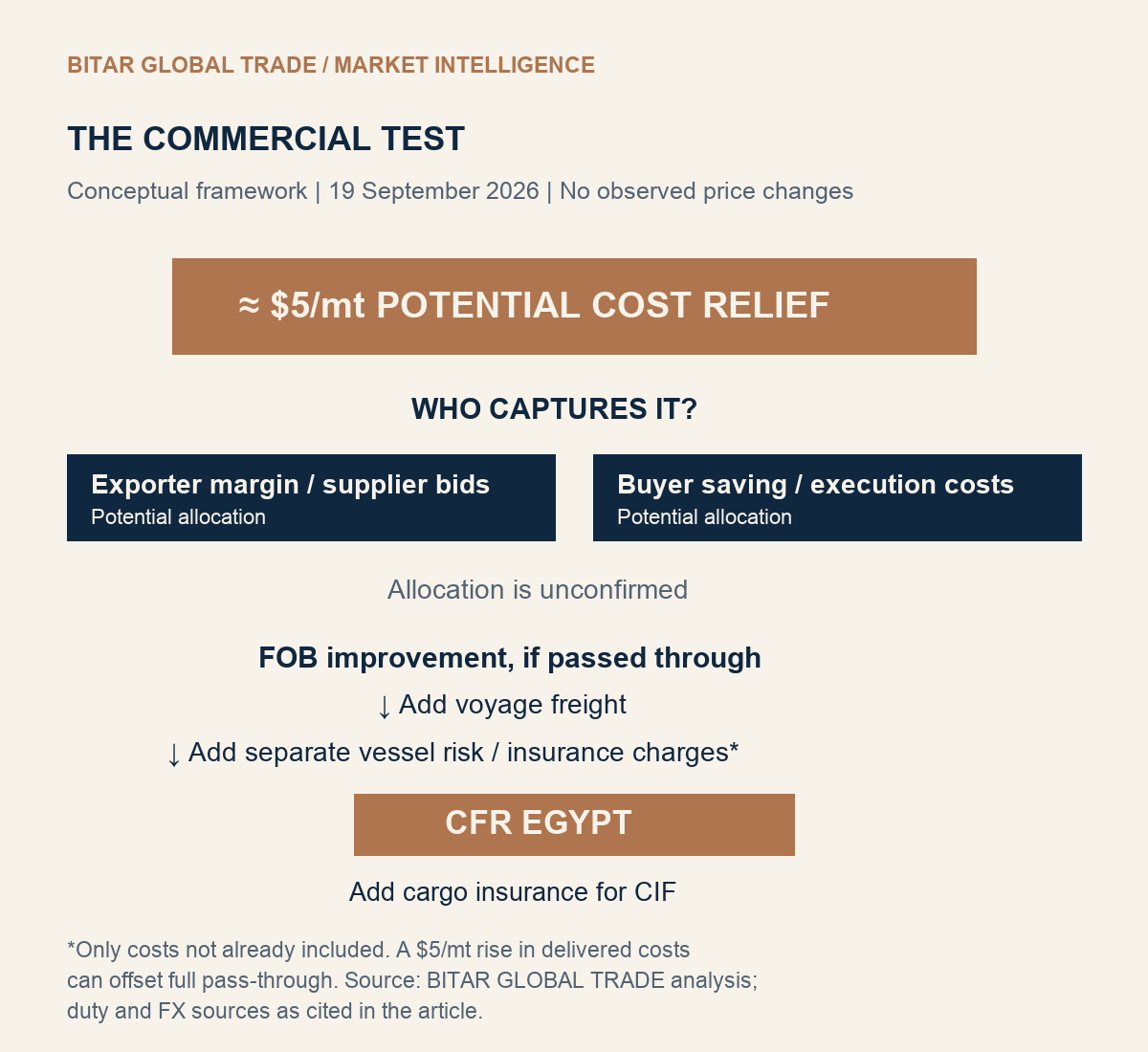
≈ $5/mt POTENTIAL COST RELIEF
versus FREIGHT + INSURANCE/RISK + EXECUTION COSTS
If the exporter retains the benefit, buyer FOB does not improve. Partial pass-through would improve FOB by the amount conceded; in the isolated full-pass-through sensitivity, that improvement approaches $5/mt.
A $5/mt increase in freight or other delivered costs could fully offset it. Conversely, elevated but unchanged freight would still allow a passed-through FOB reduction to improve delivered economics.
The duty headline alone therefore cannot establish stronger CFR/CIF competitiveness into Egypt.
Implications for Egypt & MENA Buyers
An Egyptian wheat buyer should request refreshed Russian 12.5% offers using identical specifications, volume, origin and loading port, shipment window, payment terms and destination. Each offer should identify its terminal, loading arrangements and price validity.
The first negotiating question is whether expected duty relief is already reflected in the quoted FOB price. The next is whether the refreshed offer improves delivered economics against alternative origins using actual route-specific freight.
The commercial bridge is:
| Step | Treatment |
|---|---|
| Executable Russian FOB | Start with the seller’s confirmed quotation |
| Applicable price improvement | Deduct only an additional, agreed concession |
| Voyage freight | Add the quotation for the specified cargo and laycan |
| Separate vessel insurance/risk charges | Add only where applicable and excluded from freight |
| CFR destination | Resulting commercial price basis |
| Cargo insurance | Add where CIF is required |
| Financing, discharge and other buyer costs | Include where relevant to full landed economics |
Export duty should not be added again where it is already incorporated in the seller’s FOB economics. The approximately $5/mt benefit should not be deducted twice.
Owner or vessel insurance/risk surcharges are distinct from cargo insurance. Each charge must be allocated according to the quotation and contract.
Reliable matched FOB, freight and insurance quotations are unavailable for an absolute CFR/CIF Alexandria calculation. The appropriate result remains a conditional cost comparison, rather than an invented delivered price.
What Traders Should Watch Next
The next commercial evidence should come from comparable offers around 23 September: how much changes, what duty assumption the seller uses, and whether freight or procurement costs move simultaneously.
Contracts spanning rate changes should specify the pricing assumption and treatment of subsequent adjustments. The published period ends on 29 September; that rate should not automatically be carried into October pricing.
BITAR GLOBAL TRADE View
The duty change creates roughly $5/mt of potential commercial flexibility—not an automatic $5/mt discount.
The opportunity for buyers emerges only if Russian exporters pass part of that relief into executable offers. For Egypt and MENA, the decisive benchmark is whether the resulting FOB improvement survives freight, insurance and execution costs.
The next decisive market signal is not the duty announcement itself, but comparable executable Russian 12.5% wheat offers before and after 23 September.
Bitar Global Trade welcomes direct dialogue with verified buyers, suppliers and logistics partners on current requirements, comparable offers and trade execution.
Sources
- Interfax, 11 September 2026: Ministry-attributed rates and reference prices for 16–22 September.
- Interfax, 18 September 2026: scheduled rates for 23–29 September and the suspension implementation qualification.
- Zerno.ru published rate table: corroborating weekly figures.
- Bank of Russia, effective 19 September 2026: official exchange-rate reference.
- Reuters-sourced market report, 18 September: Baltic offer context; not a normalized competitiveness benchmark.
Published duty figures are cross-checked across Ministry-attributed reporting and the cited rate table. Calculations, sensitivities and commercial inferences are BITAR GLOBAL TRADE analysis.
Five indicators for the next 7–14 days
- Applicable duty treatment: implementing notices, any confirmed suspension and the rate following 29 September.
- FOB pass-through: matched Russian 12.5% executable offers before and after 23 September.
- Benefit allocation: Russian procurement bids and RUB/USD movements alongside exporter quotations.
- Delivered-cost absorption: vessel-specific freight, separate risk charges and loading-delay exposure into Egypt.
- Origin competitiveness: matched Russian, Romanian, Bulgarian and French CFR/CIF offers and completed MENA business.